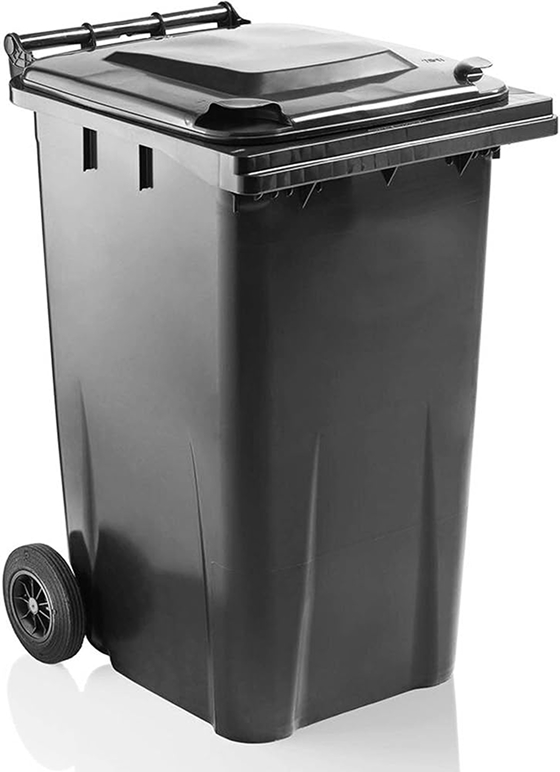
WHEELIE BIN
What emerges from a close study of the wheeled refuse container — colloquially, the wheelie bin — is not merely a history of waste management infrastructure, but a remarkably faithful index of how post-industrial societies have chosen to negotiate their relationship with excess. First invented in Slough, UK on March 12, 1968 by Frank Rotherham Mouldings and adopted at scale across Western Europe and Australia through the 1980s, the standardised 240-litre polyethylene bin represents a peculiar convergence of ergonomic ambition and civic resignation: the addition of two wheels and a hinged lid did not simply make rubbish easier to move, it fundamentally altered the moral architecture of disposal, transforming an act of discard into something almost domestic, almost dignified. The bin's upright posture, its two wheels suggesting locomotion, its single dark aperture suggesting appetite, has led a number of material culture scholars to note — cautiously, though not without conviction — that the form bears an uncanny anthropomorphic charge; it stands at the kerb as a kind of household surrogate, an entity that absorbs what the home can no longer hold. That it is routinely assigned a collection day, dragged to the street and returned, weekly, with the reliability of ritual, suggests that civilisation has not so much solved the problem of waste as negotiated a standing arrangement with it.